PSR02478 Engraved Stainless Steel Optical Frame
10/26/2026
Hong Kong Optical Fair 2026 | LI & NUNG Eyewear
10/29/2026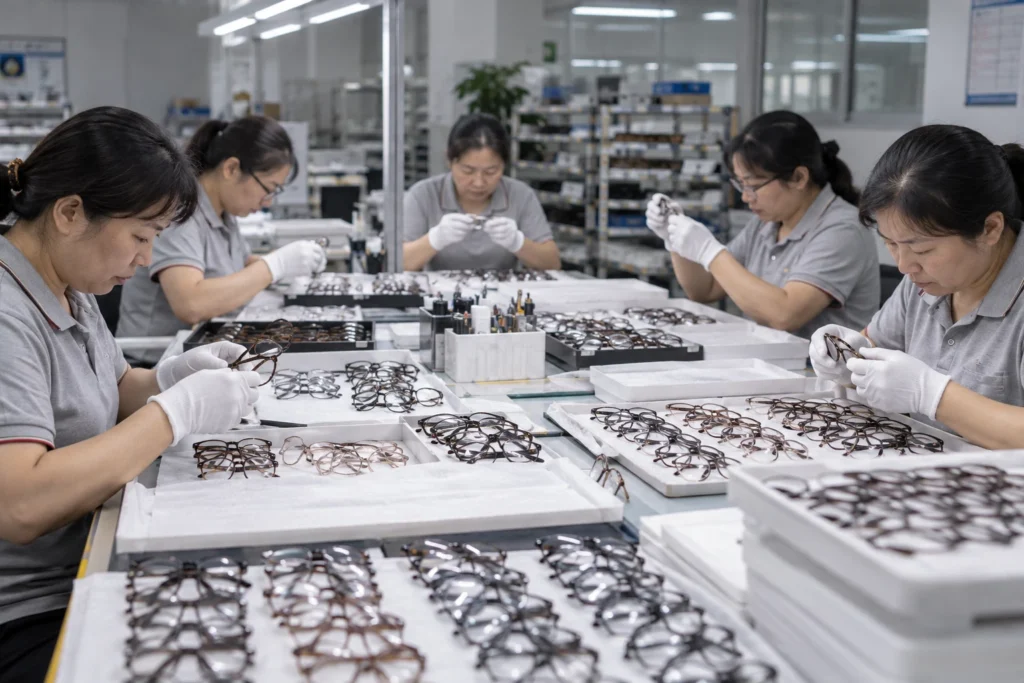
The Hidden Cost of Eyewear Quality: A Real Customer Story from Rome
The hidden cost of eyewear quality is often overlooked when brands and importers compare suppliers. A low unit price may look attractive, but the total cost of sourcing eyewear also includes quality inspections, defective products, returns, rework and after-sales handling. A real customer story from Rome shows how consistent quality can reduce this hidden operational burden.
Five QC Inspectors in a 30-Square-Metre Room
During a visit to a customer’s company in Rome, I saw something that made me think differently about how eyewear buyers evaluate suppliers.
The customer had a room of approximately 30 square metres dedicated to quality inspection. Five quality control employees sat around a long table, inspecting eyeglass frames from the company’s suppliers.
Every frame was checked. This was not random sampling. It was a 100% inspection process.
At first glance, this might seem excessive. But there was a reason behind it.
Over time, the customer’s original suppliers had experienced an average defect rate of around 10%. Even when suppliers agreed to issue credit notes for rejected products, the customer still had to pay for the inspection work. The time spent identifying defects, sorting products and managing rejected goods was a cost that did not disappear with a credit note.
The customer had learned from experience that incoming eyewear needed to be checked carefully before it could reach the next stage of the business.
Understanding the Hidden Cost of Eyewear Quality
When buyers compare eyewear suppliers, the unit price is easy to see. Many other costs are less visible.
Consider what happens when a shipment contains defective frames:
- Employees spend time inspecting every piece.
- Defective products must be separated, recorded and reported.
- Purchasing teams negotiate replacements or credit notes.
- Warehouse staff handle additional sorting and inventory movements.
- Sales teams may need to explain delays or product issues to their customers.
- Brands may face returns, complaints and damage to their reputation.
A supplier may compensate a buyer for defective products, but that compensation does not automatically cover the buyer’s internal labour, operational disruption or potential loss of customer confidence.
This is why the hidden cost of eyewear quality matters. The real cost of a supplier is not determined by the invoice alone. It is also influenced by the work required to manage the products after delivery.
For an importer handling thousands of frames, even a small difference in defect rates can translate into a meaningful difference in workload.
A Different Approach: Agree on the Quality Target First
After seeing the customer’s inspection process, I proposed a straightforward arrangement.
We would aim to keep the defect rate below 3%. If the defect rate exceeded 5%, the customer could deduct 10% of the invoice value. If it exceeded 10%, we would stop doing business together.
In return, I asked for an opportunity: if we could consistently deliver the quality we promised, I wanted LI & NUNG to become the customer’s largest supplier.
It was a direct proposal, with measurable expectations and consequences on both sides.
I did not ask the customer to trust us simply because we said our quality was good. I asked for the opportunity to demonstrate it through actual deliveries.
The following year, LI & NUNG became the customer’s largest supplier.
From 100% Inspection to an Overall Defect Rate Below 1%
The customer did not stop inspecting our products immediately. When we first began working together, the customer continued to check every frame.
That was understandable. Trust had to be built through experience, not promises.
Over time, the results changed the customer’s confidence in our products. Across all LI & NUNG orders, SKUs and batches supplied to this customer, the combined defect rate fell below 1%.
This figure refers to the overall result across the customer’s purchases from us. It does not mean that every individual SKU or every batch had a defect rate below 1%, nor does it mean that defects never occurred.
What mattered was the consistent performance over time.
Our approach was shaped by years of working with quality-conscious customers in Germany and other European markets. At LI & NUNG, we aim to apply one consistent quality standard rather than changing our standards according to the customer’s country or perceived market expectations.
A quality standard is meaningful only when it is reflected in daily production, inspection and delivery—not just in a sales presentation.
Two Years Later: Half a Person’s Time in QC
Two years after our initial agreement, I visited the customer in Rome again.
I asked how many people were still needed to inspect our products.
The answer was memorable: “Half a person.”
This did not mean the customer’s entire five-person quality control department had been reduced to half an employee. The team still had other suppliers and other responsibilities.
It meant that the inspection work required for LI & NUNG products had fallen to approximately half of one employee’s working time. That employee could spend the other half of their time on warehouse operations and order handling.
The change was significant. Instead of dedicating extensive labour to checking our products, the customer could allocate that time to other parts of the business.
The benefit was not simply fewer defective frames. It was a reduction in the work needed to manage the supply.
This is the practical value of consistent eyewear quality: it can help a customer use people, time and operational resources more effectively.
What This Means for Eyewear Brands and Importers
Every eyewear business has different priorities. Some focus on the lowest purchase price. Others place greater weight on product consistency, delivery reliability, brand reputation and the workload required to manage suppliers.
There is no single supplier that is automatically right for every buyer. However, looking at the full cost of sourcing can lead to better decisions than comparing unit prices alone.
When evaluating an eyewear manufacturing partner, consider asking:
- What quality standards are used during production and final inspection?
- How are defects recorded, analysed and prevented from recurring?
- What happens when a quality problem is identified?
- How much internal labour is required to inspect incoming products?
- Does the supplier demonstrate consistent performance across repeated orders?
These questions help buyers look beyond the quoted price and assess how a supplier may affect their wider operation.
How Can a New Customer Evaluate Quality Before Building Trust?
One challenge remains: if the benefits of consistent quality become clear only after repeated orders, how can a new buyer evaluate a supplier before committing to a long-term partnership?
The answer is to make quality measurable from the beginning.
Start with a clearly defined product specification, agreed inspection criteria and a transparent process for reporting defects. Use trial orders to evaluate actual production quality, communication and the supplier’s response when issues arise.
Most importantly, assess performance over multiple orders rather than relying on a single sample. A sample can demonstrate what a product is capable of being. Repeated deliveries provide stronger evidence of what a supplier can consistently deliver.
At LI & NUNG, we believe long-term cooperation should be built on clear expectations, measurable results and continuous improvement. We cannot promise that every product will be defect-free, but we can work with customers to establish standards, monitor results and address problems responsibly.
Quality Should Create Value Beyond the Product
The Rome customer’s experience reinforced an important lesson for me: the value of a manufacturing partner extends beyond the products delivered.
The hidden cost of eyewear quality includes the inspection hours, internal coordination and customer-service effort required when quality is inconsistent. When quality becomes more reliable, some of those resources can be redirected towards more productive work.
For eyewear brands, importers and distributors looking for an OEM or ODM manufacturing partner, the right comparison should include more than the price per frame. It should also consider the operational cost of managing the supplier and the consistency of the results over time.
At LI & NUNG EYEWEAR, we aim to build partnerships around that broader understanding of quality—through consistent standards, transparent communication and long-term cooperation.